Skip to content
JW
Data systemSupporting evidence2025

Hive Movie-Rating Analytics

HIVE课程设计

A Hive-based movie-rating analytics and visualisation system covering warehouse modelling, HDFS storage and interactive reporting.

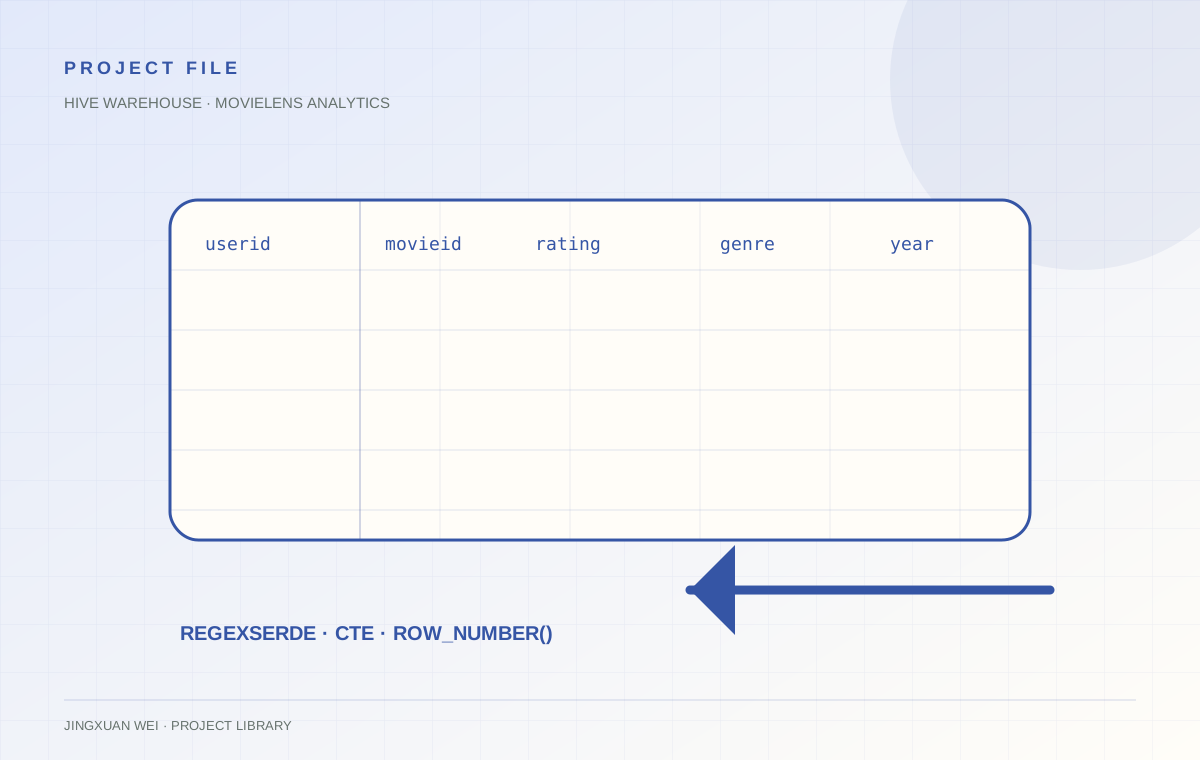
Hive Movie-Rating Analytics project diagram

34p

system report

03

core tables

SQL

warehouse analysis

01 / Overview

What this package actually contains.

The Hive coursework built a movie-rating warehouse over HDFS and used Hive SQL to answer questions about genre quality, regional preferences and the relationship between ratings and release year.

Objectives

  • 01Ingest MovieLens-style users, movies and ratings into Hive tables.
  • 02Model the data for SQL aggregation and window-function analysis.
  • 03Produce ranked genre and regional movie results suitable for visualisation.

Data flow

From raw records to a usable service.

The pipeline is the main story: ingestion, storage, processing and serving.

01

MovieLens files

Users, ratings and movie metadata separated by multi-character delimiters.

02

Hive tables

RegexSerDe definitions and HDFS-backed external data.

03

SQL layer

CTEs, explode, joins and window functions.

04

Docker stack

Hadoop, Hive, YARN and MySQL metadata services.

05

Reporting

Top genres by year and top movies by region.

02 / Package highlights

What this work demonstrates.

  • Demonstrates SQL-style aggregation and warehouse design over HDFS.
  • Uses a Docker-based stack with Hive, Hadoop, YARN and MySQL metadata services.
  • Extends the data-engineering portfolio beyond Spark and HBase.

03 / Implementation

Where the engineering complexity sits.

01

Semi-structured input handling

The raw MovieLens files use :: delimiters rather than standard CSV. The Hive tables therefore use RegexSerDe with explicit capture groups, preserving the original IDs and textual fields without a pre-processing file rewrite.

  • Ratings are loaded from ratings.dat into a typed Hive table.
  • Movie titles are parsed to extract a four-digit release year.
  • Genres are exploded from a pipe-delimited field into one row per genre.
02

Window-function analysis

The analytical queries aggregate ratings by movie, join movie metadata, then use ROW_NUMBER() partitioned by year or region. This produces a ranked result without hand-written loops or client-side sorting.

  • CTEs keep each aggregation step readable.
  • The year/genre query finds the highest-rated genre per year.
  • The regional query finds the highest-rated movie per postal region.

04 / Key code

Code that defines the pipeline.

Only verified source excerpts and pseudocode taken from the project papers are shown.

Verified project codeHive SQL

RegexSerDe ratings table

Original Hive DDL for loading MovieLens ratings with :: delimiters.

USE moviedb;

CREATE TABLE ratings (
  userid      BIGINT,
  movieid     BIGINT,
  rating      DOUBLE,
  rating_time STRING
)
ROW FORMAT SERDE 'org.apache.hadoop.hive.serde2.RegexSerDe'
WITH SERDEPROPERTIES (
  'input.regex'='^(.+?)::(.+?)::(.+?)::(.+?)$',
  'output.format.string' = '%1$s %2$s %3$s %4$s'
)
STORED AS TEXTFILE;

LOAD DATA LOCAL INPATH '/tmp/ratings.dat'
OVERWRITE INTO TABLE ratings;
Verified project codeHive SQL

Top genre per year

Original Hive query using CTEs, explode and a partitioned window function.

WITH movie_ratings AS (
  SELECT movieid, AVG(rating) AS rating_avg
  FROM rating
  GROUP BY movieid
),
movie_with_year_genre AS (
  SELECT
    movieid,
    CAST(SUBSTR(title, -5, 4) AS INT) AS year,
    explode(split(genres, '\\|')) AS genre
  FROM movie
  WHERE title RLIKE '\\(\\d{4}\\)$'
),
ranked_genres AS (
  SELECT
    year,
    genre,
    AVG(rating_avg) AS genre_avg_rating,
    ROW_NUMBER() OVER (
      PARTITION BY year
      ORDER BY AVG(rating_avg) DESC, genre ASC
    ) AS rn
  FROM movie_with_year_genre
  JOIN movie_ratings USING (movieid)
  GROUP BY year, genre
)
SELECT year, genre, ROUND(genre_avg_rating, 3)
FROM ranked_genres
WHERE rn = 1
ORDER BY year;

Operational notes

  • RegexSerDe avoids an extra parsing step for the :: delimiter format.
  • Window functions push ranking into the warehouse instead of the UI.
  • The Docker setup makes the multi-service Hadoop/Hive environment repeatable.

Limitations / next steps

  • A production warehouse would use partitioned ORC/Parquet tables rather than text files.
  • The current dataset is small enough that interactive query latency is not representative of scale.

05 / Downloads

Files in this folder.

Open the original report, presentation or source archive. PDF cover pages with private details were removed.

PDF

Movie analytics report

中文 · 33 pages · 3.0 MB

Sanitized 33-page report on the data model and visual analytics system.

Open file
ZIP

Source archive

Mixed · 81 KB

Curated Hive coursework source package.

Download ZIP