An end-to-end machine-learning project that analyses student attributes and predicts academic progression outcomes.
26p
course report
~1.3
labelled MAE
06
base model families
01 / Overview
What this package actually contains.
The machine-learning coursework predicts a student’s final grade from demographic, family, study-habit and prior-term variables while controlling for leakage. The strongest saved model is labelled with an MAE of approximately 1.3.
Objectives
01Explore which student and family features correlate with final performance.
02Compare linear, tree-based, boosting and stacking regressors.
03Build a reusable preprocessing and model-evaluation pipeline.
ML workflow
Data, features, model, evaluation.
The page focuses on leakage control, feature engineering and model comparison.
01
Student data
Academic, demographic, family and lifestyle attributes.
02
Feature engineering
Prior-grade means, differences, alcohol total and parental education.
03
Models
Ridge, Random Forest, ExtraTrees, XGBoost, LightGBM and CatBoost.
04
Stacking
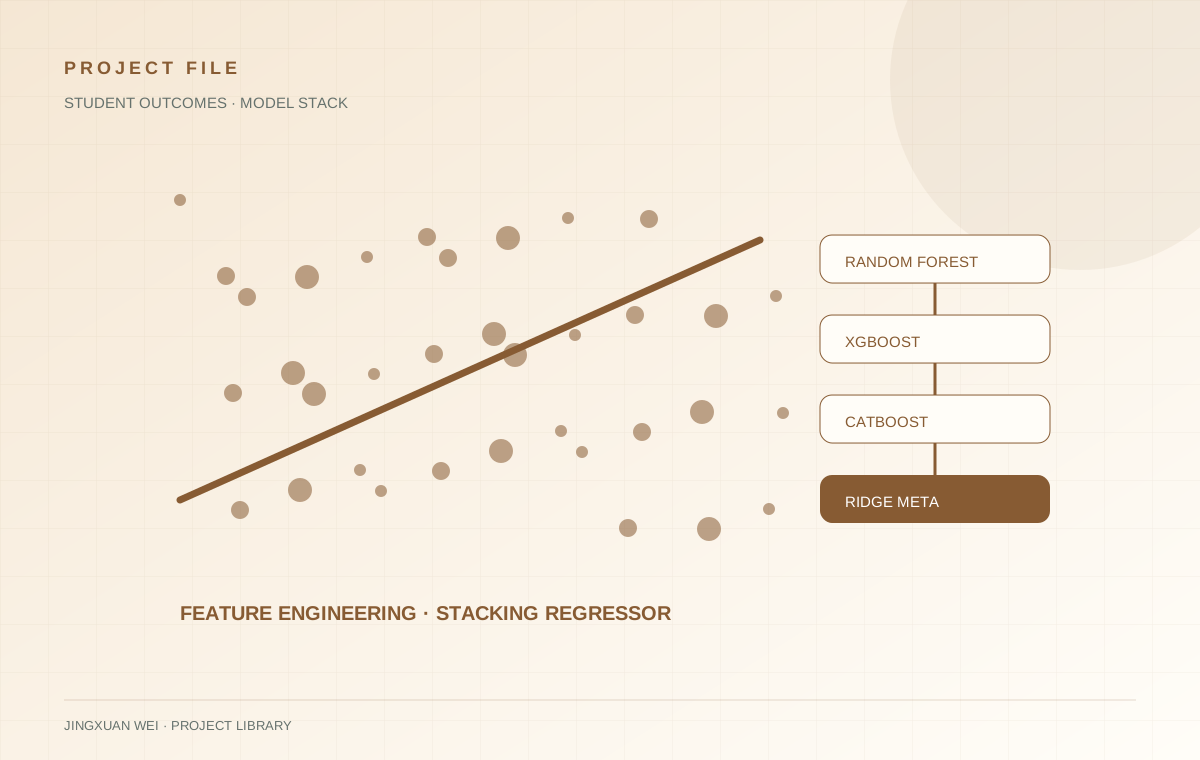
Ridge meta-learner combining base regressors.
05
Evaluation
MAE, RMSE, R² and saved best model.
02 / Package highlights
What this work demonstrates.
Covers data preparation, exploratory analysis, model comparison and evaluation.
Translates tabular education data into a complete predictive workflow.
Adds a clean supervised-learning example to the broader modelling portfolio.
03 / Model design
What shaped the predictive performance.
01
Feature engineering and leakage
The project creates interaction and context features such as prior-grade averages, grade change, combined alcohol consumption and parental education. The original notebook explicitly notes the importance of removing G1 and G2 from the feature set in some experiments to avoid target leakage into the final-grade prediction.
02
Why stacking
The target is tabular and moderately sized. A stack of linear, bagged-tree, extremely randomised tree and gradient-boosting models captures different error patterns. A Ridge meta-learner keeps the combination stable and passes the original features through to the second stage.
03
Evaluation
The workflow compares MAE, RMSE and R² across models and saves the best-performing estimator. The resulting artifact is labelled “Ultimate_Student_Model_MAE_1.3”, indicating the project’s approximate mean absolute error target.
04 / Key code
Feature and model implementation.
Only verified source excerpts and pseudocode taken from the project papers are shown.
Verified project codePython
Domain feature engineering
Original Python excerpt for feature construction and leakage control.