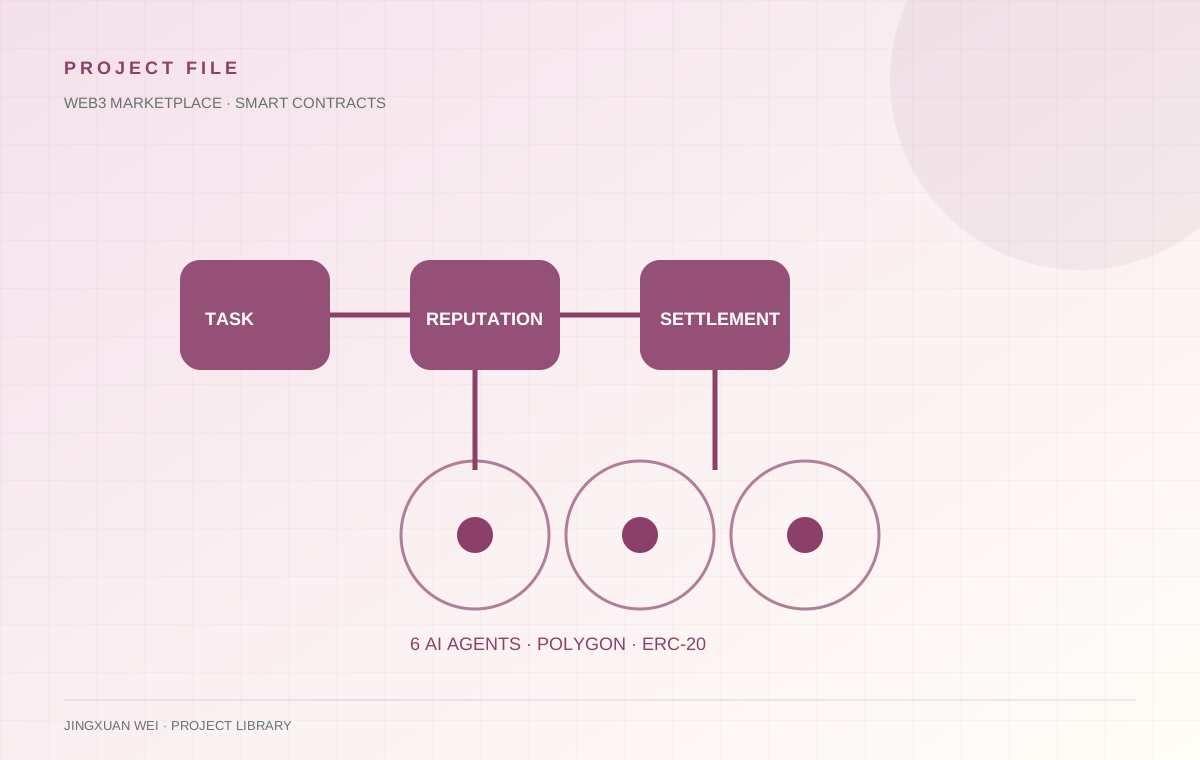
A Web3-enabled knowledge-work marketplace with ERC-20 settlement, task and reputation contracts, plus AI-agent workflows for matching and contract management.
03
smart-contract modules
06
AI agents
24
pitch-deck pages
01 / Overview
What this package actually contains.
TalentLink combined smart-contract settlement with AI-assisted recruitment workflows. The system design covered task management, reputation, ERC-20 asset settlement and six agent roles for matching, scoring and contract support.
Objectives
01Automate task contracting, delivery confirmation and settlement between clients and knowledge workers.
02Represent reputation as an on-chain primitive that can be updated after completed work.
03Connect multiple AI workflows to a knowledge base and matching interface.
Product mechanics
User surface, mechanism, automation.
The system is explained through its modules and the behaviour they enable.
Module01
Task module
Scope, milestone, deadline and completion state.
Module02
Reputation module
Bounded on-chain score updated after verified outcomes.
Module03
Settlement module
ERC-20-based payment and platform fee logic.
Module04
AI agents
Matching, reputation, contract and delivery-support workflows.
Module05
Polygon
Contract deployment after Sepolia testing.
02 / Package highlights
What this work demonstrates.
Connects three smart-contract modules with six AI-assisted talent workflows.
Explains the Polygon deployment, token economy and contract settlement model.
Provides a sanitized project proposal, presentation and source archive without private team information.
03 / Mechanism
How the product works end to end.
01
Contract mechanism design
The project separated task, reputation and settlement concerns into three contract modules. Reputation was represented as a bounded integer to avoid floating-point arithmetic and to make score changes auditable through events. The ERC-20 asset module handled payment movement and platform accounting.
Reputation updates emit events so both the application and external indexers can track changes.
Bounds prevent a score from becoming negative or growing without limit.
Task and settlement state were designed to make delivery and payment observable.
02
AI-agent layer
Six agents handled different parts of the workflow: recruitment matching, reputation scoring, contract management and related support tasks. Few-shot fine-tuning and a local legal knowledge base were used to ground the contract-analysis experience and improve task-specific outputs.
Retrieval-augmented generation provided context beyond the base model prompt.
Few-shot examples were used where labelled task data was limited.
The product proposal focused on flexible workers and contract-risk review.
03
Deployment and learning
Contracts were tested on Sepolia before deployment to Polygon. This made the development path reproducible and exposed chain-specific configuration issues before a live-network deployment.
04 / Key code
Key product and contract logic.
Only verified source excerpts and pseudocode taken from the project papers are shown.
Verified project codeSolidity
Bounded reputation contract
Original Solidity excerpt from the project’s reputation module.
ReputationSystem.sol
mapping(address => uint256) private reputation;

uint256 public constant INITIAL_REPUTATION = 100;
uint256 public constant MAX_REPUTATION = 200;
uint256 public constant MIN_REPUTATION = 0;
uint256 public constant REPUTATION_DELTA = 5;

function increaseReputation(address user) external {
    require(
        reputation[user] >= MIN_REPUTATION,
        "User reputation not initialized"
    );

    if (reputation[user] + REPUTATION_DELTA > MAX_REPUTATION) {
        reputation[user] = MAX_REPUTATION;
    } else {
        reputation[user] += REPUTATION_DELTA;
    }

    emit ReputationIncreased(user, reputation[user]);
}

function decreaseReputation(address user) external {
    require(
        reputation[user] >= MIN_REPUTATION,
        "User reputation not initialized"
    );

    if (reputation[user] < REPUTATION_DELTA) {
        reputation[user] = MIN_REPUTATION;
    } else {
        reputation[user] -= REPUTATION_DELTA;
    }

    emit ReputationDecreased(user, reputation[user]);
}
Verified project codePython
Legal retrieval chain
Verified Python excerpt from the TalentLink / LawGuard prototype.